Explore the offer

Advanced Characterization and Fine Analysis / Optical and luminescence spectroscopy

RAMAN
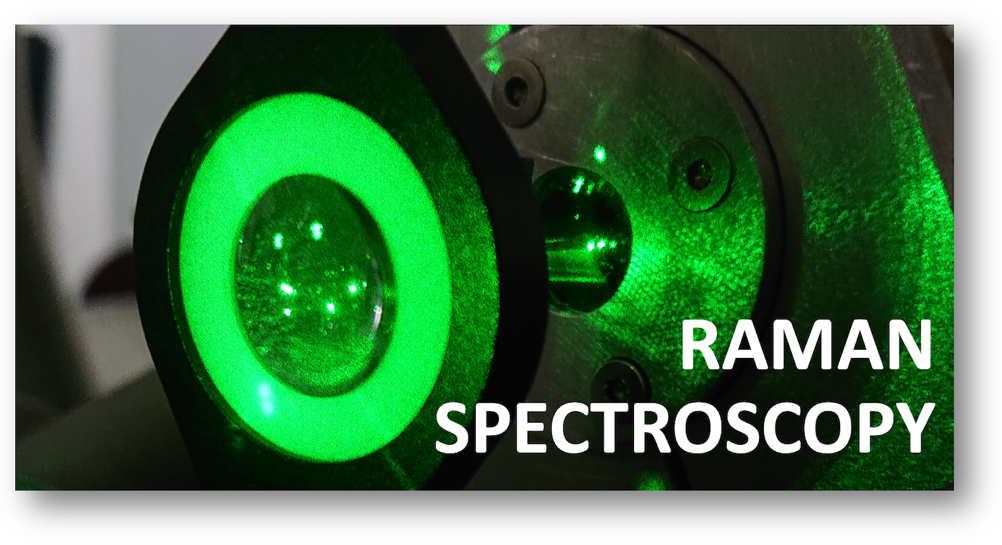
Through dispersive analysis of inelastically scattered radiation, Raman spectroscopy provides a powerful means to access vibrational modes in condensed matter, yielding complementary information to IR spectroscopy. In a confocal back-scatter geometry through a microscope objective, µ-scale resolution can be obtained from a dielectric sample

Inelastic scattering of radiation occurring in the Raman effect is a process where energy is transferred to/from the optical field to molecular or crystal vibrations in a mechanism mediated by the structural parameters’ dependent polarizability. Raman spectroscopy is a widespread technique owing to the fact it can be applied with essentially no need for sample preparation, providing fast non-destructive information on chemical or crystallographic structure. Raman signal can be obtained from a sample embedded in a transparent medium, thus a strong potential for in-operando characterization is inherent with the technique and contributes to its continuous growth in applied science.

Available instruments

Select instruments to view their specifications and compare them (3 max)

Lab's Facility

Milano

UNIMI-Fisica

Instruments' description and comparison

Also consider

AFM is a surface sensitive technique permitting to obtain a microscopic image of the topography of a material surface. Typical lateral image sizes are within a range of only a few Nanometers to several 10 Micrometers, whereas height changes of less than a Nanometer may be resolved.

A fine tip attached to a cantilever is scanned across the material surface and enables to measure height changes exploiting an optical beam deflection system (a laser that is reflected from the rear side of the cantilever onto a segmented photodiode). The position of a laser spot on the photodiode permits to track height changes as e.g. due to a nano-particle on the surface or an atomic terrace of a single crystal surface. A feedback loop controls the tip-surface distance and therefore ensures stable imaging conditions.

Different operation modes like contact or non-contact mode can be used to optimize the imaging conditions with highest lateral resolution on one hand and least sample interaction on the other hand. Measurements in different environmental conditions (liquid, gas,...) on a broad class of samples (smooth, rough, insulating, conductive, soft, stiff, wet, dry...) can be performed.

Choosing suitable tips and imaging modes, additional surface properties can be mapped together with the topography, with similar spatial resolution, like friction force, magnetization and surface potential, surface charge density and electrical resistance, as well as elastic modulus and adhesion of heterogeneous sample surfaces can be obtained. 

Read more

AFM

Atomic Force Microscopy

Advanced Characterization and Fine Analysis