Explore the offer

Advanced Characterization and Fine Analysis / Scanning probe microscopy

Scanning Tunneling Microscopy
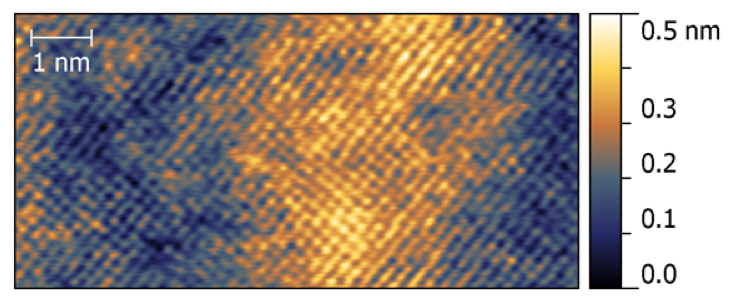
Scanning Tunneling Microscopy (STM) allows imaging conductive surfaces at the atomic scale. It is possible to characterize the distribution of surface terraces and steps, as well as to determine the atomic arrangement of (ordered) surface (over)structures.

In STM, an atomically sharp tip is scanned on a surface at a few-angstrom distance, while a bias voltage is applied between these two electrodes, so that a current flows due to the quantum tunneling effect. The intensity of the tunneling current depends exponentially on the tip-surface distance and can therefore be used to reconstruct a morphologic image.

STM is a local technique: while high-resolution can be achieved on small (nanometer sized) areas, information on large-scale (micron sized or more) is lost, and measurements have to be repeated systematically on several regions of the sample to get statistically relevant information.

Due to stability performances, STM experiments are typically time-consuming. The technique is applicable both in air and in vacuum. Ultra-high-vacuum (UHV) is required for the characterization of delicate, atomically clean systems and for performing measurement at cryogenic temperature.

The STM signal is not purely topographic, but brings also information on the local density of electronic states. Scanning tunneling spectroscopy (STS) is an extension of STM that provides information about the density of electrons in a sample as a function of their energy. Inelastic tunneling spectroscopy (IETS) is a challenging extension for the investigation of vibrational states at liquid helium temperature. The STM tip can also be used to manipulate single atoms and molecules.

By acquiring sequences of consecutive images, STM can also be used to investigate at the atomic scale dynamical processes occurring on the surface of conductive samples, with a typical acquisition time of few tens of seconds per image. To further extend the range of accessible details in this kind of measurements, NFFA-Europe makes for the first time available to external users the access to a FastSTM option for high-speed imaging with a VT-STM microscope at CNR-IOM.  Thanks to this option, it is now possible to image with atomic resolution dynamical processes as chemical reactions, diffusion and growth, with a frame rate up to 100 images per second on regions few-nanometer wide.

Available instruments

Select instruments to view their specifications and compare them (3 max)

Lab's Facility

Trieste

CNR-IOM@TS

Trieste

CNR-IOM@TS

Napoli

CNR-SPIN@NA

Instruments' description and comparison

Also consider

Ultrafast spectroscopy (or Pump-probe spectroscopy) is a technique used to study the dynamics of excited states in various materials, such as molecules, semiconductors, and solids.

It involves the use of two laser pulses. The first laser pulse, the "pump," excites the sample, elevating electrons from the ground state to an excited state. This initiation creates a non-equilibrium condition in the sample. After a controlled delay, a second laser pulse, the "probe," is sent through the sample. The probe pulse interrogates the sample to gather information about the transient states and the evolution of the excited states over time.

By varying the delay time between the pump and probe pulses, researchers can create a time-resolved picture of the dynamic processes occurring in the material. This time resolution can be on the order of femtoseconds (10^-15 seconds), allowing scientists to observe ultrafast phenomena.

These techniques provide insights into ultrafast processes, such as electronic transitions, high-order harmonics generation, molecular vibrations, and energy transfer mechanisms, that occur on very short time scales. It helps in understanding the fundamental properties of materials, such as the relaxation times of excited states, carrier dynamics in semiconductors, topological effects and the mechanisms of photochemical reactions.

Other possible studies can cover the world of solar cells, light-emitting devices, and photocatalysts, where understanding the dynamics of excited states is essential for improving efficiency and performance. Moreover, in biophysics and biochemistry, pump-probe spectroscopy can be used to investigate the dynamics of biomolecules, such as the folding and unfolding of proteins, photosynthesis mechanisms, and the behavior of molecular motors.

Read more

US

Ultrafast-Spectroscopy

Advanced Characterization and Fine Analysis

CVD is a thermal process because a certain thermal energy is needed to decompose the gas precursors and reassemble them in the material to be synthetize. Generally,  in a CVD process, the substrate is maintained at high temperature while it is exposed to the volatile precursor/s, usually carried by an inert carrier gas (like Ar). High temperatures are usually required to decompose the precursors and to reassemble the products in the growing material.The use of a catalyst may allow to decrease the process temperature and to select the location and the nanostructure of the growning film. Together with the carrier and precursor gasses, other gasses, like etching gasses (like H2, NH3, …), may be used to avoid the formation of undesired species and to enhance the synthesis of the desired material. In high pressure CVD (atmospherics pressure) the use of an inert carrier gas helps to avoid gas-phase reactions (homogenous deposition) and favor the synthesis trough surface processes (heterogeneous deposition). When CVD is done at low pressure, the process is called Low Pressure CVD (LPCVD). In this case the reactions in the gas-phase of the precursors are reduced and the higher diffusivity of the precursor species favor to decorate cavities and led to get homogeneous coatings when a topography is present. The homogeneity is also spurred by the process temperature, which favors the mobility of the atomic/radical species along the surface. Process pressures are usually in the millitorr-torr range and process temperatures range is 400-800C (depending on the energy needed to decompose the precursors). To favor the precursor gas decomposition and to lower the CVD temperature, the CVD process may be assisted by a plasma, and in this case the technique is referred as plasma-enhanced CVD (PECVD). This usually allows lowering the temperature of the process to a few hundred centigrade degrees, which can be run on less temperature resistant substrates or without setting off temperature triggered unwanted processes. 

The present implementation of the technique is suitable for mm to cm-size samples as those typically studied by spectroscopy and microscopy.

Read more

CVD

Chemical Vapour Deposition

Growth & Synthesis