Explore the offer

Advanced Characterization and Fine Analysis / Optical and luminescence spectroscopy

Cathodoluminescence
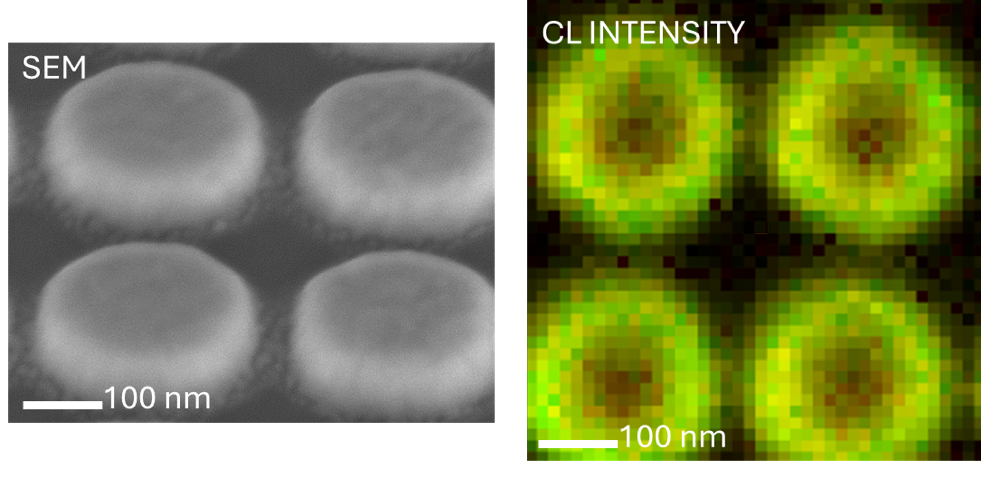
The cathodoluminescence (CL) tool is integrated onto a scanning electron microscope (SEM) equipped with a field emission gun source. The source operates with an energy range of 2-30 keV, enabling spatial resolution down to a few nm. Luminescence spatial resolution can further vary from 10 nm to hundreds of nanometers depending on the chosen electron beam energy and the material being analyzed. It can be used for analysis of material properties (charge carrier recombination, electronic transition) and detection of defects or impurities. The samples are mounted on a sample holder, an intra-column optical collection system coupled with a dispersive spectrometer and two detectors permits the spectral analysis of luminescence emission from 350 nm to 1500 nm. This system offers a way to extract spatially resolved electronic and/or optical properties of luminescent material and devices.

Available instruments

Select instruments to view their specifications and compare them (3 max)

Lab's Facility

Lecce

CNR-NANOTEC@LE

Instruments' description and comparison

Also consider

Ultrafast spectroscopy (or Pump-probe spectroscopy) is a technique used to study the dynamics of excited states in various materials, such as molecules, semiconductors, and solids.

It involves the use of two laser pulses. The first laser pulse, the "pump," excites the sample, elevating electrons from the ground state to an excited state. This initiation creates a non-equilibrium condition in the sample. After a controlled delay, a second laser pulse, the "probe," is sent through the sample. The probe pulse interrogates the sample to gather information about the transient states and the evolution of the excited states over time.

By varying the delay time between the pump and probe pulses, researchers can create a time-resolved picture of the dynamic processes occurring in the material. This time resolution can be on the order of femtoseconds (10^-15 seconds), allowing scientists to observe ultrafast phenomena.

These techniques provide insights into ultrafast processes, such as electronic transitions, high-order harmonics generation, molecular vibrations, and energy transfer mechanisms, that occur on very short time scales. It helps in understanding the fundamental properties of materials, such as the relaxation times of excited states, carrier dynamics in semiconductors, topological effects and the mechanisms of photochemical reactions.

Other possible studies can cover the world of solar cells, light-emitting devices, and photocatalysts, where understanding the dynamics of excited states is essential for improving efficiency and performance. Moreover, in biophysics and biochemistry, pump-probe spectroscopy can be used to investigate the dynamics of biomolecules, such as the folding and unfolding of proteins, photosynthesis mechanisms, and the behavior of molecular motors.

Read more

US

Ultrafast-Spectroscopy

Advanced Characterization and Fine Analysis